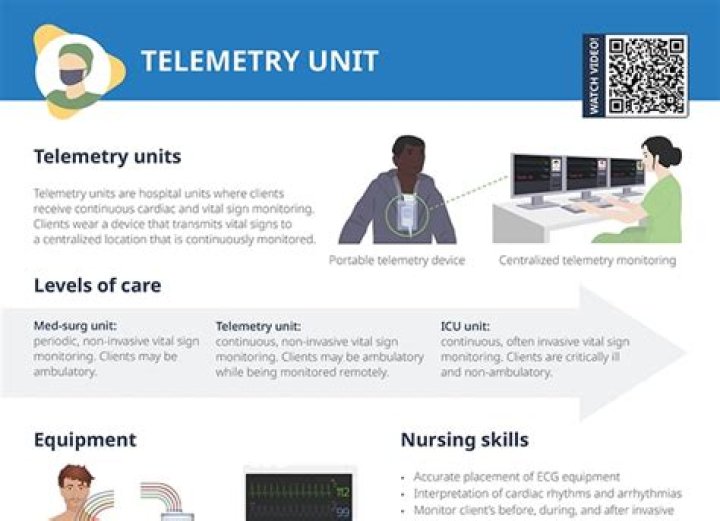
Cardiac telemetry is a way to monitor a person's vital signs remotely. A cardiac telemetry unit usually involves several patient rooms with vital sign monitors that continuously transmit data, such as your heart rate, breathing, and blood pressure, to a nearby location.
What type of patients are on the telemetry unit?
A telemetry nurse works with patients who suffer from heart disease, heart failure and complications associated with cardiac conditions. Telemetry nurses may also provide medical care to patients recovering from cardiac procedures like coronary bypass surgeries or stent placements.Is the telemetry unit ICU?
Telemetry nurses work within telemetry units of hospitals. These units provide critical care and are fast paced work environments. In the Intensive Care Unit (ICU), patients battle severe or life-threatening illness and injuries.What is the difference between telemetry and ICU?
ICU is critical care and PCU, or progressive care, is considered an intermediate level of care based on The Centers for Medicare and Medicare Services definitions. Telemetry is a technology, not a level of care.What can I expect from a telemetry unit?
The telemetry unit changes the signals into pictures of each heartbeat. The pictures are sent to a monitor that looks like a television screen. The monitor displays the picture of your heartbeat continuously and trained nurses watch the monitor 24 hours a day. The monitor collects information about your heart.Heart Month: What it's Like Working in the Telemetry Unit
Why are patients put on telemetry?
Non-intensive telemetry units are utilized for monitoring patients at risk for life-threatening dysrhythmias and sudden death. Physicians often use monitored beds for patients who might only require frequent nursing care.Is telemetry a step down unit?
Stepdown units – also known as progressive care units (PCUs), telemetry, intermediate care and transitional care units – provide a path of safety for patients who were once critically ill, and are trying to make their way home.Is telemetry the same as cardiac unit?
Cardiac telemetry is a way to monitor a person's vital signs remotely. A cardiac telemetry unit usually involves several patient rooms with vital sign monitors that continuously transmit data, such as your heart rate, breathing, and blood pressure, to a nearby location.What do nurses do in telemetry?
Telemetry Nurses are in demand due to the specialized knowledge required for this niche area of nursing. What is a Telemetry Nurse? A Telemetry or Progressive Care Nurse monitors patients with heart disease and other serious medical conditions using an electrocardiogram or other vital sign measuring devices.Is telemetry acute care?
Telemetry nurses fall under the category of progressive care nurse, as defined by the American Association of Critical Care Nurses (AACN), which supports nursing professionals, including telemetry nurses, who care for acutely and critically ill patients.Is telemetry the same as Med Surg?
Telemetry floors have patients that require cardiac monitoring and more frequent vitals/assessment than a med/surg patient. You can also push different IV drugs if the patient is on the monitor. Some places have techs that watch the rhythms and others place that responsibility on the nurses.What does a telemetry device do?
Telemetry – A portable device that continuously monitors patient ECG, respiratory rate and/or oxygen saturations while automatically transmitting information to a central monitor.Is a telemetry nurse Med Surg?
Some telemetry nurses start as Med-Surg nurses who train to become Telemetry nurses while others begin as New Grads. Telemetry nurses must be both BCLS and ACLS certified and become very skilled at setting up and reading EKGs so that they can intervene immediately to assist the patient.When should a patient be on telemetry?
Telemetry is generally recommended for patients admitted with any type of heart disease, including:
- Acute myocardial infarction with ST-segment elevation or Q waves on 12-lead electrocardiography (ECG)
- Acute ischemia suggested by ST-segment depression or T-wave inversion on ECG.
