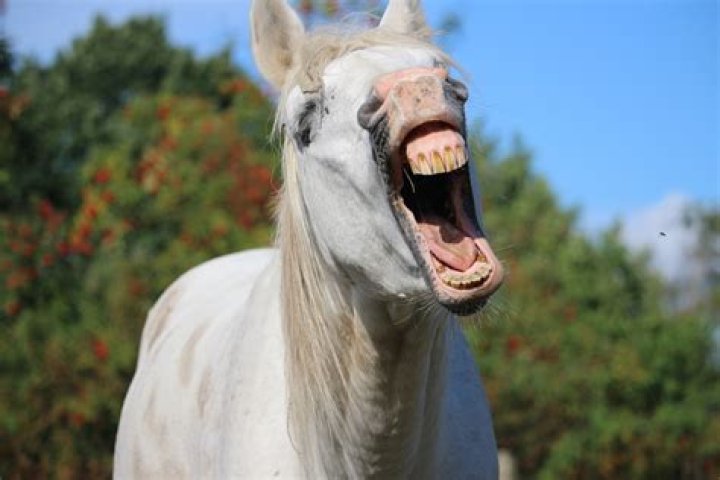
Frequent yawning in horses can be a symptom of gastric ulcers, gastrointestinal discomfort, tempo-mandibular tension/pain, and/or liver distress. Horses frequently yawn following the removal of the bridle, presumably to release the tension in their jaw muscles.
What does it mean when my horse yawns?
Horses yawn for a wide variety of reasons including excess stress or anticipation, relief from gastrointestinal distress, physical pain or discomfort, or as a social behavior signaling dominance. Your horse may also yawn following a time of quiet or rest.Why do horses yawn after riding?
Some horses actually yawn while being ridden, which can mean they're using a calming or appeasement signal. A calming signal means some sort of stress is taking place, and they're trying to release tension and calm down.Do horses yawn when bored?
Research suggests that yawning in horses may be related to frustration or other highly charged emotions. “Yawning is commonly considered to be the effect of boredom or drowsiness,” says Aleksandra Gorecka-Bruzda, PhD, of the Polish Academy of Sciences.Why does my horse yawn when I put his bridle on?
The Connection Between Bridling and YawningBridling could be one cause of stress and discomfort for a horse. Putting something like a bridle on the head doesn't look too comfortable, regardless of what animal you are. It is possible that there is a correlation between bridling and yawning in horses.
Why Do Horses Yawn?
How do you tell if a horse trusts you?
Here are 8 Signs a Horse Likes and Trusts You
- They Come Up to Greet You. ...
- They Nicker or Whinny For You. ...
- They Rest Their Head on You. ...
- They Nudge You. ...
- They Are Relaxed Around You. ...
- They Groom You Back. ...
- They Show You Respect. ...
- They Breathe on Your Face.
How do horses show affection?
Horses will often show affection to humans as they would to other horses. Horses show their affection through grooming, nuzzling, rubbing, resting their heads on you, and even licking. Learning their body language will help you understand when they are showing affection.What does it mean when a horse smacks its lips?
The lip curl (Flehmen response) is a natural gesture when a horse is presented with a new smell, and is common in breeding stallions around mares. I wrote another record dedicated to the lip curl. Some horses flap their lips loudly when they are nervous or anxious, or anticipating an undesirable event.Why do horses roll their eyes?
Rolling eyes and pinned ears mean an unhappy, unstable horse."What are the symptoms of colic in horses?
Signs of colic in your horse
- Frequently looking at their side.
- Biting or kicking their flank or belly.
- Lying down and/or rolling.
- Little or no passing of manure.
- Fecal balls smaller than usual.
- Passing dry or mucus (slime)-covered manure.
- Poor eating behavior, may not eat all their grain or hay.
Is it normal for horses to yawn a lot?
Frequent yawning in horses can be a symptom of gastric ulcers, gastrointestinal discomfort, tempo-mandibular tension/pain, and/or liver distress. Horses frequently yawn following the removal of the bridle, presumably to release the tension in their jaw muscles.Do horses hearts sync with humans?
When our horses interact with us, they tend to synchronize to our heartbeats as well, meaning they can sense slight adjustments in our mood.Why do horses blink?
In horses, an increase in spontaneous blink rate was associated with a more anxious temperament accompanied by more movement, while a decrease in spontaneous blink rate was associated with more docile behaviour [37].Do horses sleep standing up?
Because horses are big animals, their blood flow can be restricted by laying down for long periods of time. This causes excess pressure on their internal organs, which is why they only lay down for REM sleep. This results in them sleeping while standing up at various points throughout the day.Can horses see out of fly masks?
The term fly mask, as it implies, is a cover used on the eyes, jaw and ears of horses to help protect them from pesky flies and other insects. Though the mask may look like the horse is being blinded, it's actually semi-transparent which allows the horse to see.Why do horses wiggle their nose?
Extended wiggling nose: shows intention to search pockets or engage in mutual grooming. Nose wrinkling: sign of annoyance, pain; with ears back indicates mild threat. Relaxed nostrils and soft muzzle: neutral, relaxed.Why do horses open their mouths?
When a horse opens their mouth they are reacting to the pain or tension. This is a type of evasion, the horse is trying to evade the pressure. The pressure being the discomfort or pain.Where should you not touch a horse?
As tempting as it is, don't pet the horse's head. Continue to face his shoulder from the side, petting the neck. Most horses enjoy a scratch on the neck just behind the ear or on the withers at the highest point of the shoulder. Discontinue petting if the horse backs away or shows disinterest.How do you tell if a horse is happy to see you?
Happy horses will have their ears forward and alert, engaged in their surroundings and moving towards where they are listening. Unhappy horses may have their ears pinned back or softly drooping.Do horses like kisses?
Kissing and hugging are human ideas of affection. Horses do “spar” (play fight) and bite at the lips, but that's even more of a reason not to kiss them there. Keep your horse's lips away from your lips. You don't want him to think you're playing and be bitten.Why shouldn't you look a horse in the eye?
Never look a horse in the eyeYou're only a predator if you intend to eat what you're looking at. Horses can easily tell the difference between a predator looking to eat and predator looking in curiosity and wonder. Horses do, however, struggle to understand the intention of a human who hides his eyes.
