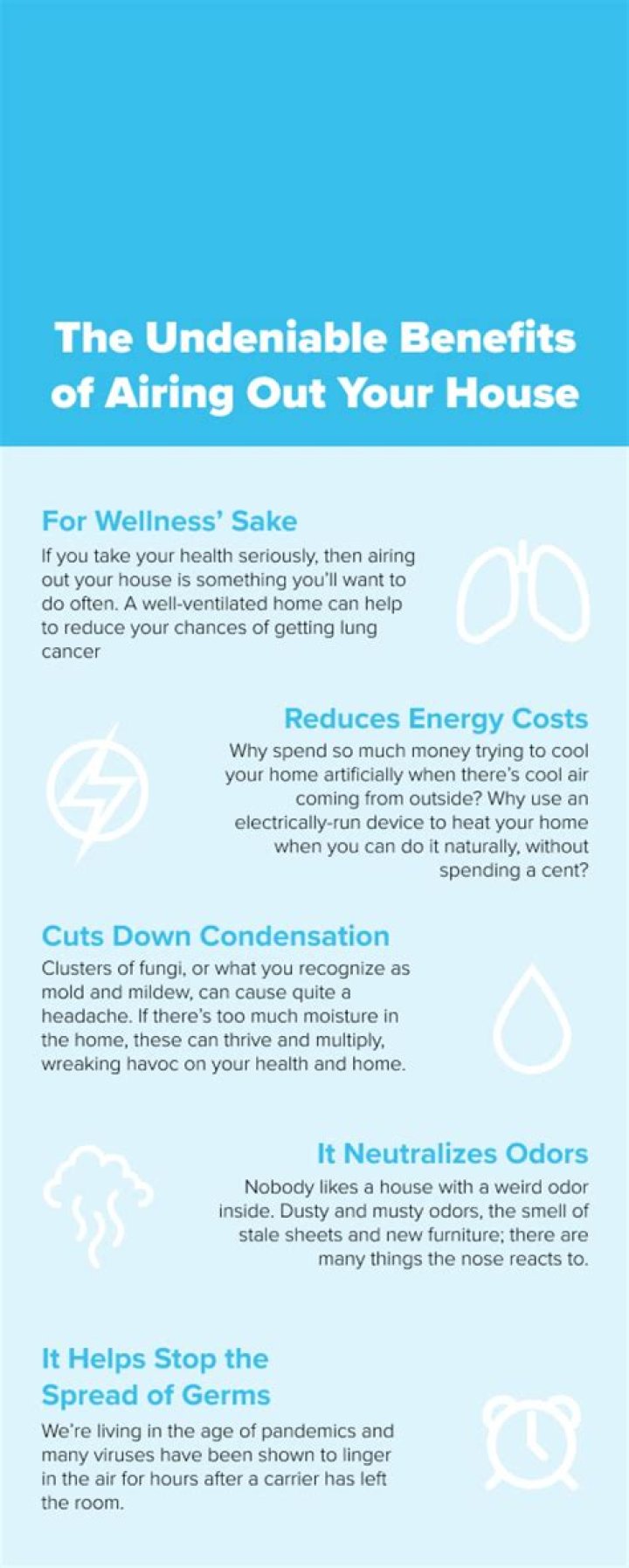
Properly airing your house is absolutely essential. In particular, it: eliminates domestic pollutants (solvents, maintenance products, glue, ammonia, fungus spores and mould, etc.) reduces tobacco pollution.
How often should you let your house air out?
If the air outside is warmer than your thermostat setting, you're raising your indoor temperature, making your AC work harder to cool your home. So how often should you open your windows? It's recommended that you do so once a day, for at least five minutes. Fifteen to 20 minutes is preferable.Does airing out a room help with Covid?
Ensuring proper ventilation with outside air can help reduce indoor airborne contaminants, including SARS-CoV-2, the virus that causes COVID-19, and other viruses. However, by itself, increasing ventilation is not enough to protect people from exposure to the virus that causes COVID-19.How long should you let your house air out?
How, then, to keep your IAQ A-OK? Prevailing wisdom is that at least 5 minutes—and ideally 15 to 20 minutes—a day of ventilation significantly improves indoor air quality. For a strong ventilation, open the front and back door, along with windows on the path in between, to get the baddies out.What happens if you don't air out your room?
When your house isn't aired out, the indoor air becomes stuffy and stagnant, and carbon dioxide and other toxins accumulate in the air. Any indoor projects like painting will further infuse this indoor air with toxins and odors that can be harmful to your health.What Happens If Never Open Window | Window is Best for Ventilation | Whole-House Ventilation System
Is it good to air out your room?
Without proper air ventilation in the home, the house almost becomes a box of hot, steamy germs. By opening all the windows and doors you can let out this damp air and reduce the amount of condensation in your home.How long does Covid stay in the air in a house?
Transmission of COVID-19 from inhalation of virus in the air can occur at distances greater than six feet. Particles from an infected person can move throughout an entire room or indoor space. The particles can also linger in the air after a person has left the room – they can remain airborne for hours in some cases.Does keeping a window open help with Covid?
Ventilation is most important if someone in your household has COVID-19, or when you have visitors in your home. Opening windows and doors is the easiest way of improving ventilation. Also open any window vents or grilles. Opening windows at opposite sides of the room or home is a good way of changing the air.How do you purify air from Covid?
Portable air cleaners, also known as air purifiers or air sanitizers, are designed to filter the air in a single room or area. Central furnace or HVAC filters are designed to filter air throughout a home. Portable air cleaners and HVAC filters can reduce indoor air pollutants, including viruses, that are airborne.What happens if you never open windows?
Not only can keeping openings closed cause condensation issues inside your house (i.e. weeping windows), which we know can lead to mould, it also allows toxins already inside the home to build up. That includes volatile organic compounds, mold spores, dust, smoke, radon, viruses and bacteria.Is it good to air out your house in the winter?
In the winter, ventilation is important, since you'll have windows open less often, or not at all, to keep the cold air outside. The air inside your home may be up to 10 times more polluted than the air outdoors.What air filter kills coronavirus?
Filtration is the most common approach used to capture airborne SARS-CoV-2, and it generally gets the thumbs up from scientists and regulatory agencies. Many devices rely on the high-efficiency particulate air (HEPA) filter, which traces its origins back to the gas masks of World War II.How long does Covid stay on bed sheets?
A study published in found that at room temperature, COVID-19 was detectable on fabric for up to two days, compared to seven days for plastic and metal. However, when it was exposed to high heat, the virus became inactive within five minutes.How long is Covid contagious?
Most people with COVID-19 are no longer contagious 5 days after they first have symptoms and have been fever-free for at least three days.How long do Covid aerosols stay in the air?
Its scientists artificially sprayed SARS-CoV-2 aerosols in the air and reported that the majority stopped being infectious within 10-20 minutes, with most of that loss happening within the first five minutes. Prof. Jiménez tweeted that while the experiments were very elegant, the conclusions were overstretched. Prof.How do you ventilate a house with Covid?
Below are ways you can improve ventilation in your home. Use as many ways as you can (open windows, use air filters, and turn on fans) to help clear out virus particles in your home faster.
...
Use fans to improve air flow
- Place a fan as close as possible to an open window blowing outside. ...
- Point fans away from people.
