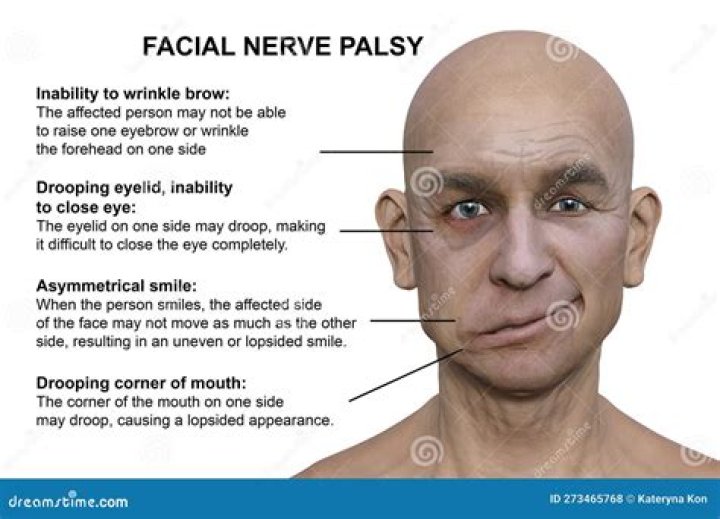
Mild cases of Bell's palsy may not require any treatment. The symptoms may go away on their own in a few weeks and not cause any long-term problems. For more server or complicated cases, the treatment will depend on the symptoms and your overall health.
What is a mild case of Bell's palsy?
Signs and symptoms of Bell's palsy come on suddenly and may include: Rapid onset of mild weakness to total paralysis on one side of your face — occurring within hours to days. Facial droop and difficulty making facial expressions, such as closing your eye or smiling. Drooling.Can Bell's Palsy happen slowly?
Symptoms of Bell's palsy tend to come on suddenly and reach peak severity within 48 to 72 hours. Some people develop mild symptoms. Others experience total paralysis. Symptoms start to gradually improve in three weeks.How long does a mild case of Bell's palsy last?
Generally, Bell's palsy affects only one side of the face; however, in rare cases, it can affect both sides. Symptoms appear suddenly over a 48 - 72-hour period and generally start to improve with or without treatment after a few weeks, with recovery of some or all facial function within six months.How do you know if you've had Bells Palsy?
somebody's face droops on 1 side (the mouth or eye may have drooped) a person cannot lift up both arms and keep them there. a person has difficulty speaking (speech may be slurred or garbled)2-Minute Neuroscience: Bell's Palsy
Can Covid 19 cause Bell's palsy?
But, COVID-19 can also present with other central nervous system manifestations such as stroke, encephalo-myelitis, or peripheral nervous manifestations such as Guillain-Barré syndrome (GBS) and Bell's palsy.Is Bell's palsy caused by stress?
Bell's Palsy is a neurological condition in which the seventh facial nerve is not working properly, causing paralysis of one side of your face. Most people don't know that Bell's Palsy is most often brought on by stress and over use of your brain.What is difference between Bell palsy and facial palsy?
In Bell's palsy there is inflammation around the facial nerve and this pressure causes facial paralysis on the affected side. Facial nerve palsy is the most common acute condition involving only one nerve, with Bell's palsy being the most common cause of acute facial paralysis.Why is my face drooping one side?
Bell's palsy is also known as “acute facial palsy of unknown cause.” It's a condition in which the muscles on one side of your face become weak or paralyzed. It affects only one side of the face at a time, causing it to droop or become stiff on that side. It's caused by some kind of trauma to the seventh cranial nerve.Does Bell's palsy hurt your face when it is healing?
For those who have prolonged recovery from Bell's palsy, pain may be due to the facial muscles being stiff or tight, and help from a physiotherapist or speech and language therapist who specialises in facial palsy may be beneficial.How long does it take for facial nerves to heal?
Within three months, most people have recovered full motion and function of their face. A delay in recovery is often accompanied by some form of abnormal facial function. But if facial paralysis from Bell's palsy doesn't get better, there are effective treatment options.How do you test for Bell's palsy?
There's no specific test for Bell's palsy. Your health care provider will look at your face and ask you to move your facial muscles by closing your eyes, lifting your brow, showing your teeth and frowning, among other movements.Does sleep help Bell's palsy?
The 5 Musts-Do's When First Diagnosed with Bell's Palsy:You MUST sleep for the nerve to regenerate.
